

Can’t remember the difference between Sunnis and Shia?
You’ve come to the right place.


It feels like every ten years or so there’s a news flareup about Sunnis and Shia. Right now, people are talking about the “fanatical religion” of the Shii clerics in Iran—laughable coming from certain quarters. I mean, talk about glass houses and black pots.
But who exactly are the Shia? Sure, you can look it up on Wikipedia or read a quick explainer. But how do you remember it? How do you contextualize it? That’s where I can help.
Here are five things to remember about Shiism, packaged in my cute lil’ shrew style to help you process, internalize, and engage.
Bonus: each section comes with a handy mnemonic device invented by yours truly.
Islam 101
First, some bare-bones basics for all you beginners out there. All practicing Muslims share some central beliefs and practices.
Belief in One God. “Allah” simply means “God” in Arabic, cognate with the Hebrew Elohim. Muslims worship the same God as Jews and Christians: the God of Abraham.
Belief in Prophecy. Muhammad is the final prophet of Islam, not the only one. Muslims revere many prophets familiar from the Judeo-Christian tradition, including Abraham, Moses, John the Baptist, and Jesus.
Belief in Scripture. Muslims believe the Quran is the literal word of God, delivered to Muhammad through the angel Gabriel. Muhammad didn’t write it—God did.
The Five Pillars. 1. Affirmation of faith; 2. ritual prayer; 3. almsgiving; 4. fasting during Ramadan; and 5. pilgrimage (Hajj) to Mecca.
Both Sunnis and Shia believe all of this. So what sets them apart?

1. The split goes back to the very beginning
The seeds of the Sunni-Shia split were planted right after the death of the Prophet Muhammad—and the divide continued to evolve over centuries.
One of my pet peeves with intro textbooks is that they often present the Sunni view as the default and the Shia as a dubious add-on. But historically speaking: we don’t actually know what happened when Muhammad died. There are two equally early, divergent traditions.
According to the Shia, Muhammad did designate a successor: his cousin, son-in-law, and close companion Ali. On the return from Muhammad’s Farewell Pilgrimage in 632, the group stopped at a place called Ghadir Khumm. There, Muhammad reportedly said:
“Whoever accepts me as his mawla, Ali is also his mawla.”
The whole controversy hinges on that slippery Arabic word mawla—which can mean leader, protector, patron, or friend. (Want to read a whole dissertation about this word? You’re in luck—I wrote one!)
Shia interpret the statement as a clear designation of Ali as successor.
Sunnis generally agree Muhammad said something like this, but they argue it meant honoring Ali, not appointing him leader. After all, Sunnis like Ali, too—they just don’t elevate him head and shoulders above other early Muslims.
In the Sunni telling, Muhammad did not explicitly name a successor. After his death, there was a brief power scramble, and the person who emerged as leader was Abu Bakr, Muhammad’s close friend and father-in-law.
So the early divide wasn’t exactly “Team Ali vs. Team Abu Bakr.” It was more like:
Shia: Ali is the rightful, divinely designated leader.
Others: Let’s pick a capable leader who can keep things together.
Ali did eventually become caliph—but only after Abu Bakr, Umar, and Uthman had ruled before him. Sunnis call these four men the Rightly Guided Caliphs. The Shia say: yeah, right. Those first three were usurpers blocking Ali from his rightful position.
And that disagreement—who should rule, and why—opened the door to deeper differences about authority, interpretation, and religious leadership that would continue to grow over time.

Mnemonic device
The word “Sunni” has a U in it—and so do the first three caliphs recognized by the SUnnis: Abu Bakr, Umar, and Uthman.
The word “ShIA” has no U. Only an A and an I—just like Ali.
Also, a little song to the tune of Mary Had a Little Lamb:
Muhammad died and who should rule,
Who should rule, who should rule?
Muhammad died and who should rule?
The group could not decide.
The Shia said he named Ali,
Named Ali, named Ali—
The Shia said he named Ali,
Who stood right by his side.
The Sunnis said we just don’t know,
Just don’t know, just don’t know—
The Sunnis said we just don’t know,
Let’s choose an able guy.
2. Shiism tends to be minoritarian
Today about 90% of Muslims are Sunni and 10% are Shia. But the difference isn’t just numbers.
Sunni traditions historically place weight on consensus—the idea that the community collectively preserves the truth. Muhammad famously said (according to the Sunnis): “My community will not agree on an error.” When disagreements arise, Sunnis have often tolerated a high degree of diversity in order to keep the community unified.
Shia traditions lean the other way. They tend to assume that the majority can be disastrously wrong. Majority rule tends toward dubious, “might makes right” morality. Truth resides instead with a small group of rightly guided believers, led by a divinely inspired figure: the Imam.
Quick note on the word imam (leader):
An imam (lowercase i) can simply mean a prayer leader.
The Imam (capital I) in Shiism is something else entirely: a unique, divinely guided authority. The Leader.
Mnemonic devices:
Sunni = 5 letters long | Shia = 4 letters long | More letters = more adherents.
Another one I like (my students hate it):
“Sunni” almost contains the skeleton of Unity and Community—if you spell it Suni. I can see it clearly. My students complain about the spelling (which strikes me as strange moment to suddenly care about spelling). But to me, it’s an easy reminder that Sunnis value unity and community.
3. Shiism tends to be more top-down
Scholars often avoid comparing Islam to Christianity. The traditions are different enough that comparisons can mislead, and they often take Christianity as the model and Islam as the deviation. But pedagogically, students often find the following helpful:
Sunni Islam is somewhat like Protestantism. There is no centralized church structure. Religious scholars train at different institutions, work in different communities, and authority is relatively decentralized.
Shiism is somewhat like Catholicism. Historically, the Imam functions a bit like the Pope: a divinely guided authority whose interpretations carry enormous weight. The Imam historically had deputies and representatives who transmitted his teachings to the broader community. So the structure is more hierarchical: religious knowledge flows from the Imam through trusted intermediaries to the broader population.

Mnemonic device
Imam sounds like Mama.
Pope comes from Papa.
The Mamas and the Papas—these two groups have a more centralized, top-down structure.
4. Shiism tends to be sectarian
“Sectarian” here doesn’t mean violent or fanatical. It simply means a tendency to split into distinct sects, marked not only by doctrine but also social cohesion—Shia often practice something called wala’a wa-bara’a, loosely translated as “love your friends, shun your enemies.”
Because leadership revolves around the Imam, disputes about who the rightful Imam is often creates new sects. (Just like in the medieval period, when Catholics fought over which Pope or Anti-Pope they followed). That’s why there are multiple branches of Shiism today. The largest group—especially in Iran and Lebanon—is the Twelver Shia. When people say “Shia” they’re usually thinking of Twelvers. Guess how many Imams they recognize?
That’s right, it’s twelve. Look at you, smarty pants!
The twelfth Imam disappeared in the 9th century and is believed to be in “occultation”—waiting in heaven to return at the End of Time, somewhat like Elijah in the Jewish tradition. Twelvers await his return to usher in a messianic age of justice (more on that, later).
The clerics who govern Iran today are not Imams. They see themselves as scholars preserving the tradition until the Imam returns.
The other major Shia group is the Ismailis, found in places like India, Pakistan, and East Africa. They split from the Twelvers at the time of the seventh Imam (in the 8th century CE). The sixth imam, Jaʿfar, had two sons: Musa and Ismail. Guess which one the Ismaili’s followed?
Two for two, smarty pants—it’s Ismail!
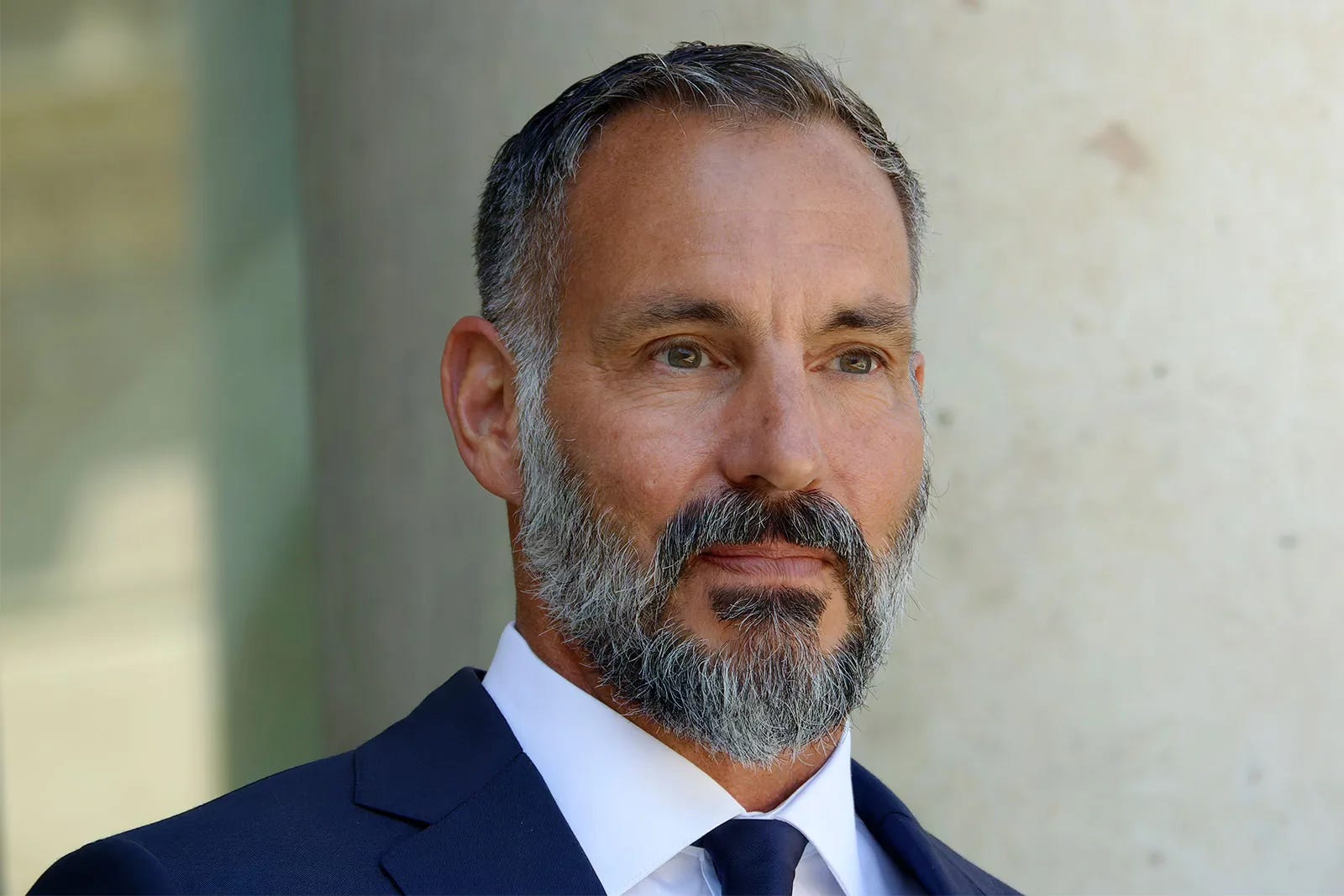
Unlike Twelvers, some Ismailis believe the line of Imams continues to the present day. The current Imam of the Nizari Ismaili branch is His Holiness Aga Khan V, who recently became leader after the death of his father in 2025. He’s a Geneva-based, Brown-educated philanthropist who supports environmental and social justice initiatives. His family also supports educational institutions like The Aga Khan University in Pakistan, and the Aga Khan Museum in Toronto. So, anytime you hear people being like “the Shia are such fundamentalists!” I hope you can provide them some gentle correction.
Mnemonic device:
“My Imam’s way or the highway.”
When Shia disagree about who the rightful Imam should be, they often split.
5. Shiism often emphasizes persecution and injustice
Partly because they have historically been a minority, Shia traditions place strong emphasis on persecution and martyrdom. Ali was assassinated. Shia tradition holds that the other Imams were also killed, usually by Sunni enemies.
The most important martyr is Hussein, the third Imam—the Prophet Muhammad’s grandson—who was killed in battle against forces loyal to the Sunni caliph. His death is commemorated annually on the holiday of Ashura, and its remains one of the central emotional events in Shia memory. There are even dramatic reenactments of his martyrdom—taʿziyeh plays—similar to Christian passion plays.
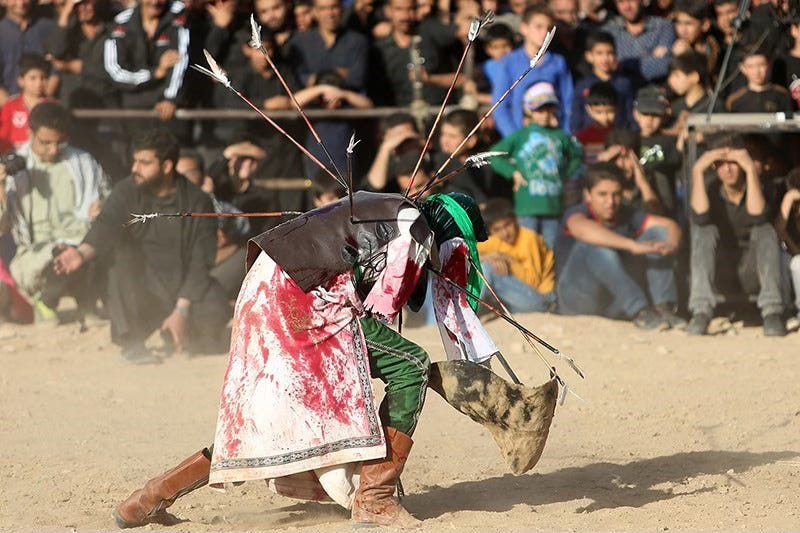
These stories reinforce a powerful narrative: the world is unjust, and even the Prophet’s family was not spared. Shia will be persecuted by the powers-that-be. It’s why Shia are allowed to practice something called taqiyya, often translated as “dissimulation” (though in Jordanian Arabic, it just means “hat.”) It means, you can pretend to be a Sunni in order to protect yourself, you fear that telling the truth about your Shiism will get you hurt. It’s not lying in the sense of trying to trick someone or pull the wool over their eyes—it’s about a persecuted minority doing their best to survive.
But the story doesn’t end there. Twelver Shia believe that one day, the truth will shine forth:
“The earth will be filled with justice as it has been filled with injustice.”
This will happen when the Twelfth Imam returns, preparing the way for the second coming of Jesus.
Yes—another little-known fact: Muslims believe Jesus did not die on the cross but was raised to heaven and will return at the end of time. The Twelfth Imam isn’t the Messiah himself (that’s Jesus), but he ushers in the messianic age.
Some commentators overplay this messianic expectation. After all, Jews and Christians also await the Messiah. Some believers expect it soon (like the anonymous person who scrawled “Jesus will return in 1996” on the blackboard of my middle school English classroom). Some think it’s far in the future. Some see it symbolically, or as a call for humans to work toward a better world. And many are too busy thinking about the laundry—or, lately, how to stay alive—to dwell on eschatology.
Mnemonic Device
The Shia Panacea. It rhymes! When the Twelfth Imam returns, all the ills and injustices of the world will be wiped away, like a perfect panacea.
A final note
There is an enormous range of belief and practice among Shia—just like in any religion. Some are strict, some lax, some mystical, some secular. Some left-wing, some right-wing. Some treat Shiism primarily as a religious identity; others as a cultural one.
Take Nowruz, the Persian New Year celebrated on the spring equinox (coming up soon). It includes eggs, flowers, greenery, candles, and even jumping over fire—imagery that traces back to pre-Islamic Iranian traditions. When Iran’s clerical government first came to power, some leaders tried to suppress Nowruz as a pagan relic. The Iranian people basically responded: absolutely not. This tradition is deeply woven into Shia cultural life—much like how Christmas and Easter incorporate older, pagan traditions in the Christian world.

That’s why every heading in this article says “tends to be.” Why can’t scholars just give simple facts? Because reality isn’t simple, folks. Shiism has patterns and tendencies—but every culture also produces countercultures. So while this article may make things clearer, don’t let them become too clear. Because that way lies closed minds and intellectual stagnation. And remember, my lil’ shrew crew—we are supposed to use our sharp lil’ teeth to cut through the bonds of ignorance, not to become ensnared in them.
I've been married to my Muslim husband for 15 years and I'm pretty sure he's a Sunni but I still forget!
Excellent timing! I am just started learning about Islamic intricacies - my first item of interest was that Shia had a stronger concept of defending the weak and downtrodden - which fits with your post I think.